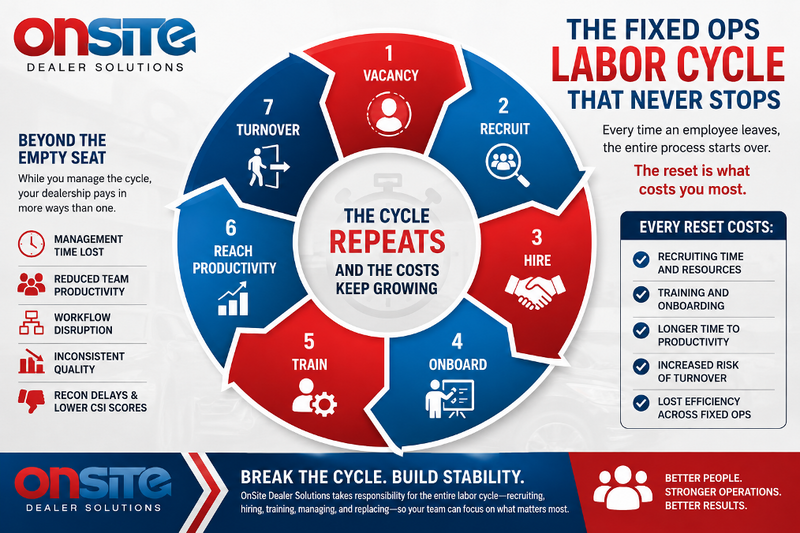
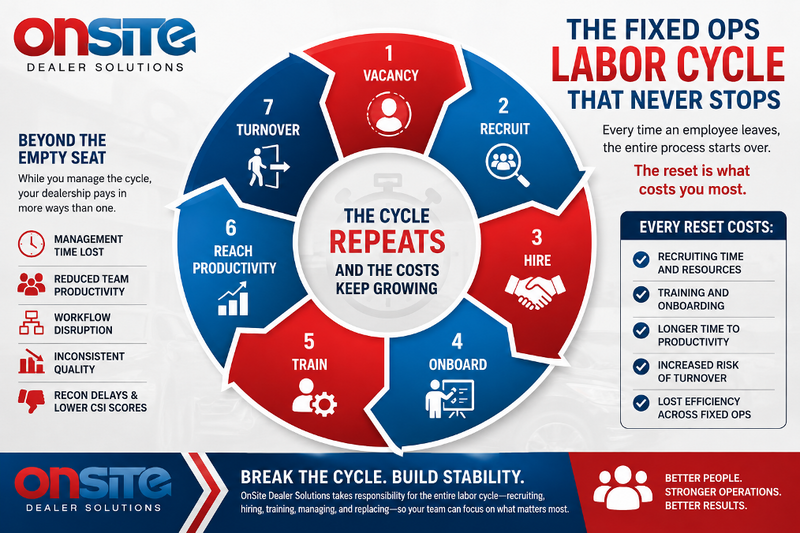
Why hiring, training, productivity, and turnover keep dealership managers stuck in the same loop.
You finally filled the open position.
After weeks of recruiting, interviewing, and trying to keep the department running short-handed, the new employee arrives.
Problem solved?
Not quite.
Now someone has to onboard them. Someone has to train them. Someone has to answer questions, check their work, correct mistakes, and help them become productive.
Eventually, they get there.
Then they leave.
And the entire process starts over.
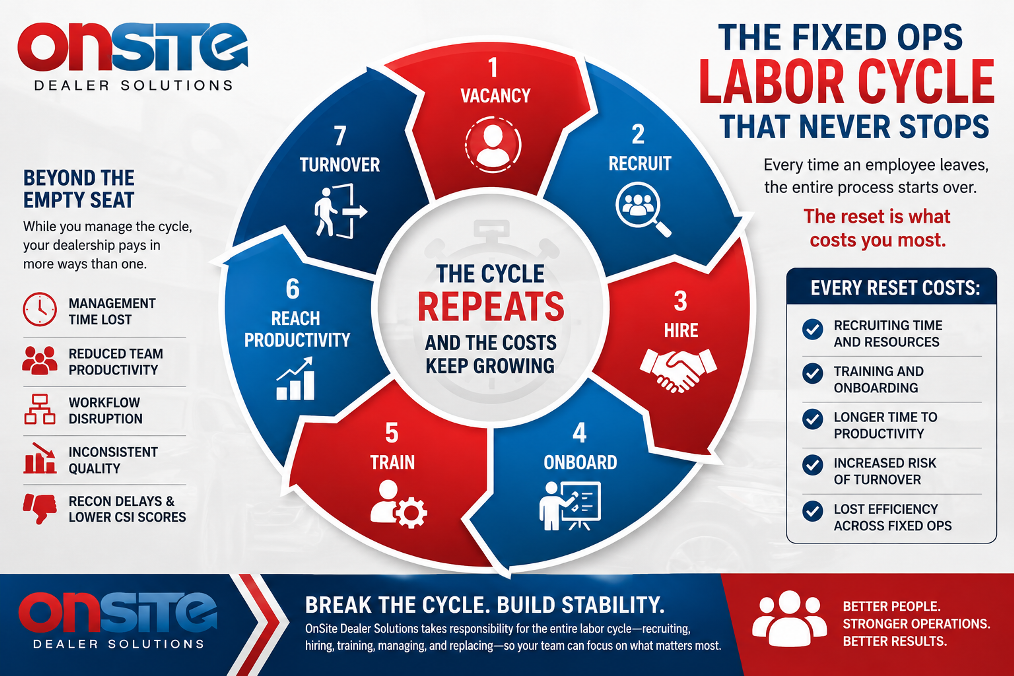
For dealerships managing detail, make-ready, reconditioning, porter, valet, and other operational positions internally, labor management isn't a one-time challenge. It's a continuous operational cycle.
Recruit. Hire. Onboard. Train. Reach productivity. Retain.
When turnover happens, reset and repeat.
The real cost isn't simply replacing an employee. It's the time, productivity, management attention, and operational consistency lost every time the cycle starts over.
Step 1: Finding the Right Employee
Before a new employee ever clocks in, someone at the dealership has already invested time in finding them.
Positions need to be posted. Applications need to be reviewed. Candidates need to be contacted. Interviews have to be scheduled. Offers need to be made. Background and employment requirements need to be completed.
Meanwhile, the work associated with the vacant position hasn't disappeared.
Vehicles still need to move through recon. Sold vehicles still need to be prepared. Service customers still expect their vehicles back. Inventory still needs to reach the front line.
Every vacant position essentially creates two jobs: finding the next employee and covering the work they aren't there to perform.
Finding the right person matters, too. Experience can help, but dependability, attitude, willingness to learn, and the ability to work within a team are often just as important.
Step 2: Hiring Doesn't Equal Productivity
Getting someone hired is an important milestone.
It isn't the finish line.
A new employee still needs to understand the dealership, their responsibilities, quality expectations, safety procedures, tools, chemicals, workflow, and the standards expected from their work.
That takes time.
It also takes someone else's time.
Managers and experienced employees often become responsible for teaching new hires while continuing to meet their own production expectations.
Great employees aren't simply hired. They're developed.
Structured onboarding, hands-on instruction, follow-up, coaching, and clear expectations help new employees become confident and productive members of the team.
The better the onboarding and training process, the faster an employee can begin contributing consistently to the dealership operation.
Step 3: The Productivity Gap
One of the most overlooked labor costs happens between an employee's first day and the day they become fully productive.
We call this the productivity gap.
The position may technically be filled, but that doesn't mean the department has immediately returned to full capacity.
A new employee may initially complete fewer vehicles, require additional supervision, ask more
questions, or need experienced employees to check their work.
That's normal. Good employees need time to learn.
The operational problem occurs when dealerships are continually repeating that ramp-up period.
If another employee or manager must regularly stop what they're doing to assist the new hire, the dealership isn't only experiencing reduced productivity from one person. The productivity of multiple employees can be affected.
Now multiply that across several positions, departments, or turnover events during the year.
Labor instability begins compounding inefficiency throughout the operation.
Step 4: Turnover Resets the Clock
Eventually, the employee becomes comfortable.
They understand the process.
Their speed improves.
Their quality becomes consistent.
Management requires less oversight.
The dealership finally begins receiving the full benefit of the position.
Then the employee leaves.
Suddenly:
- Recruiting starts again
- Interviewing starts again
- Onboarding starts again
- Training starts again
- The productivity ramp starts again
The dealership isn't simply replacing an employee. It is reinvesting the time and resources required to get another employee back to the same level of productivity.
That's why turnover costs extend well beyond another job posting or paycheck.
We explore those costs more deeply in What Is the True Cost of a High Turnover Auto Dealership Employee?, including the effect turnover can have on productivity, management resources, customer experience, and dealership performance.
When Staffing Management Becomes the Manager's Job
There is another cost that's harder to see on a financial statement.
Management attention.
- Who interviews the candidate?
- Who covers the call-off?
- Who trains the new hire?
- Who handles the scheduling problem?
- Who checks the work?
- Who addresses performance issues?
- Who starts recruiting again when the employee leaves?
In many dealerships, those responsibilities eventually fall on Service Managers, Fixed Operations Directors, Recon Managers, Used Car Managers, and other dealership leaders.
That's a problem.
A Service Manager should be focused on technician productivity, workflow, customer experience, and department performance. A Used Car Manager should be focused on acquiring, merchandising, pricing, and selling inventory.
Instead, labor instability can gradually turn dealership leaders into staffing coordinators.
We explore that exact challenge in What Happens When Your Service Manager Becomes a Staffing Coordinator?, including how daily staffing responsibilities can pull dealership leadership away from the work that drives fixed operations performance.
The occasional staffing issue may not seem significant. But when recruiting, training, scheduling, call-offs, performance management, and turnover become recurring responsibilities, they begin competing with the work dealership managers were actually hired to perform.
The Hidden Cost of Doing It Yourself
This is where the labor cycle becomes a financial issue.
When dealerships evaluate in-house labor, it's easy to focus primarily on wages.
But the employee's paycheck doesn't represent the entire cost of managing that position.
- There is recruiting.
- Hiring.
- Payroll.
- Benefits.
- Workers' compensation.
- Training.
- Management oversight.
- Turnover.
- Administrative time.
- Lost productivity.
- Potential rework.
And the operational impact when the position is vacant or underperforming.
That's why comparing an outsourced labor solution to an hourly wage doesn't tell the whole story.
Our article The Hidden Paycheck: Why In-House Recon Is More Expensive takes a closer look at the expenses dealerships can overlook when calculating the true cost of maintaining an internal recon workforce.
Breaking the Labor Cycle
Dealerships will always need great people.
The question is who should be responsible for managing the labor cycle surrounding those people?
That's where the ODS model is fundamentally different from simply filling an open position.
OnSite Dealer Solutions can take responsibility for the ongoing labor infrastructure behind the operation, including:
- Recruiting and candidate sourcing
- Hiring and W-2 employment
- Employee onboarding
- Hands-on make-ready and recon training
- Scheduling and workforce management
- Ongoing coaching and development
- Performance accountability
- Local management and operational oversight
- Recruiting and replacement when turnover occurs
In other words, the dealership isn't simply outsourcing a position. It is outsourcing the labor cycle.
That distinction matters.
When an employee leaves, the dealership shouldn't have to restart the entire process from scratch. Recruiting, onboarding, training, and workforce management remain part of the operational system.
ODS combines workforce support with dealership-focused processes and technology to create a more accountable operation. Learn more about how these pieces work together in Labor Solutions and Software to Empower Dealerships.
Let Managers Manage the Dealership
The goal of outsourcing isn't simply to have someone else hire employees.
It's to give dealership leadership time back.
When managers aren't constantly pulled into recruiting, interviewing, training, scheduling, covering call-offs, and replacing employees, they can spend more time focused on the performance metrics that actually move the dealership forward.
- Technician productivity.
- Inventory flow.
- Recon turnaround.
- CSI scores.
- Customer experience.
- 24-Hour Speed-to-Market.
- Profitability.
Those are dealership priorities.
Managing the revolving door of labor shouldn't become another full-time responsibility.
Stop Restarting. Start Improving.
The biggest challenge with dealership labor isn't simply turnover.
It's the operational reset that comes with it.
Every vacancy has the potential to restart recruiting, hiring, onboarding, training, supervision, and the climb toward full productivity.
When that happens repeatedly, labor instability can create inefficiencies that ripple throughout fixed operations, recon, inventory management, sales, and the customer experience.
OnSite Dealer Solutions was built to help dealerships break that cycle.
By managing the people, processes, training, accountability, and technology behind dealership operations, ODS allows dealership leaders to spend less time restarting and more time improving.
Because the goal isn't simply to fill the next open position.
It's to build an operation that keeps performing when people change.