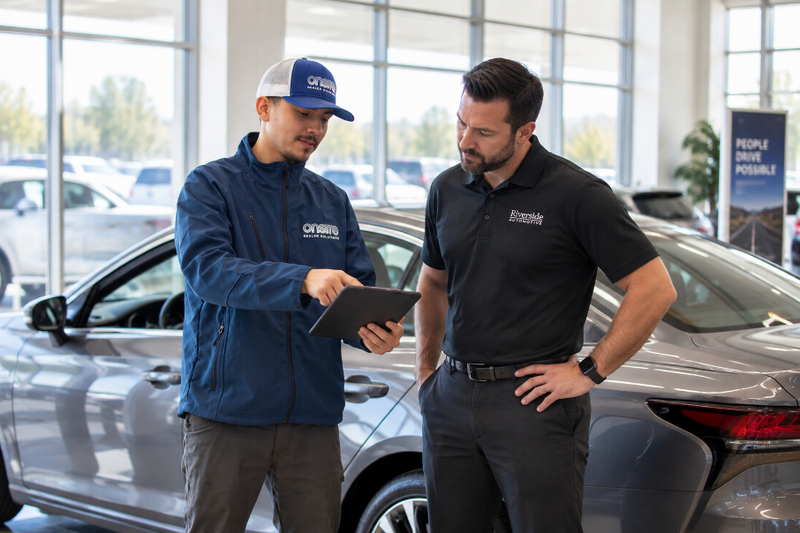
Where Training, People and Technology Work Together
Dealerships have more technology, data, and operational tools available than ever before. But technology alone doesn't create a high-performing dealership.
People still execute the process.
The strongest dealership operations aren't choosing between great people and better technology. They're finding ways to connect training, employees, processes, leadership, and technology so everyone can work more efficiently toward the same goals.
At OnSite Dealer Solutions (ODS), we believe that connection is becoming increasingly important to the future of dealership operations.
Great Technology Needs Great People
Technology can automate tasks, organize information, track vehicles, and provide valuable data. What it can't replace is an employee who understands the dealership, recognizes a quality issue, communicates effectively, and takes ownership of the work.
That's why innovation has to start with people.
Building trained dealership teams means giving employees more than instructions on their first day. Ongoing training, coaching, communication, and clearly defined expectations help create consistency long after onboarding is complete.
As we've discussed in Behind Every Great ODS Employee Is Great Training, the finished product customers see often begins with the training and processes they never see.
Training Creates Consistency
Every dealership has standards. The challenge is making sure those standards are understood and consistently executed.
Employees need to know what quality looks like, who owns each responsibility, what happens next, and how their performance contributes to the larger operation.
A simple framework helps:
- Training teaches the standard.
- Process reinforces it.
- Leadership holds it accountable.
This becomes especially important in labor-intensive areas such as detail, make-ready, reconditioning, porter services, and other Fixed Ops responsibilities.
Strong Labor Force Solutions aren't simply about filling positions. They're about building a workforce capable of consistently executing the dealership's processes.
When that doesn't happen, dealerships can find themselves stuck in the familiar cycle of recruiting, hiring, onboarding, training, losing employees, and starting over again. We explored that challenge in The Fixed Ops Labor Cycle That Never Stops.
Information Should Follow the Vehicle
Consider how many people and departments may interact with a single vehicle before it's ready for the customer:
Inventory → Inspection → Service → Recon → Detail → Photography → Front Line
Everyone can be working hard and the process can still be inefficient.
The real question is whether everyone knows where the vehicle is, what has been completed, what still needs to happen, and who owns the next step.
This is where connected technology becomes increasingly valuable.
Tools such as SERV™ Automotive Software can connect digital work orders, VIN scanning, vendor management, invoicing, reporting, and workflow tracking within the make-ready process.
Technology doesn't replace the people doing the work. It gives those people and dealership leadership better visibility into the work being done.
Innovation Should Remove Friction
Innovation doesn't have to mean adding another piece of software or chasing the newest technology.
Good innovation removes friction.
AI-powered inventory photography can shorten the path between a front-line-ready vehicle and online merchandising. Digital work orders can reduce paperwork and communication gaps. VIN scanning can make vehicle identification and workflow updates faster. Real-time reporting can help managers find bottlenecks without chasing down answers.
Our partnership with VUMO is one example. In How ODS + VUMO Redefine Dealership Speed-to-Market, we explored how AI-powered photography can become part of a more connected inventory process.
The same principle applies throughout dealership operations.
As we discussed in How Dealership Bottlenecks Kill Profit, seemingly small delays can compound as vehicles move through make-ready.
The goal shouldn't be to add more technology.
The goal should be to remove unnecessary steps from the work already being done.
Accountability Becomes Visible
Accountability shouldn't require managers to constantly ask questions like these:
- Where is the vehicle?
- Has the work been completed?
- What's holding it up?
- Who owns the next step?
- How long has it been there?
A connected operation should make those answers easier to find.
When employees understand expectations, managers have visibility, and technology supports the workflow, accountability becomes part of the process rather than another management task.
That's where people and technology begin working together instead of operating separately. It's also why we believe labor solutions and software can be more powerful when they're connected.
Connected Teams Perform Better
The dealership of the future won't be powered by people or technology. It will be powered by great people who know how to use technology to perform at a higher level.
The formula isn't overly complex:
- Training → Creates Standards
- People → Execute the Work
- Process → Creates Consistency
- Technology → Creates Visibility
- Leadership → Creates Accountability
- Innovation → Removes Friction
Together, they create better operational performance.
That's the philosophy behind ODS.
By bringing together trained W-2 employees, local leadership, dealership-specific processes, Detail Department Services, Labor Force Solutions, Specialized Reconditioning, and SERV™ technology, ODS helps dealerships connect more of the people and processes responsible for getting vehicles ready for customers.
Because when the team is connected, the entire operation can perform better.
Build a More Connected Operation
OnSite Dealer Solutions helps dealerships bring together the people, processes, and technology behind efficient make-ready and Fixed Ops operations.
Contact ODS today to learn how we can build a dealership-specific solution around your operation.